

 Industrial Water Plant



Best Water Purifier for Large Families (5–8 Members)

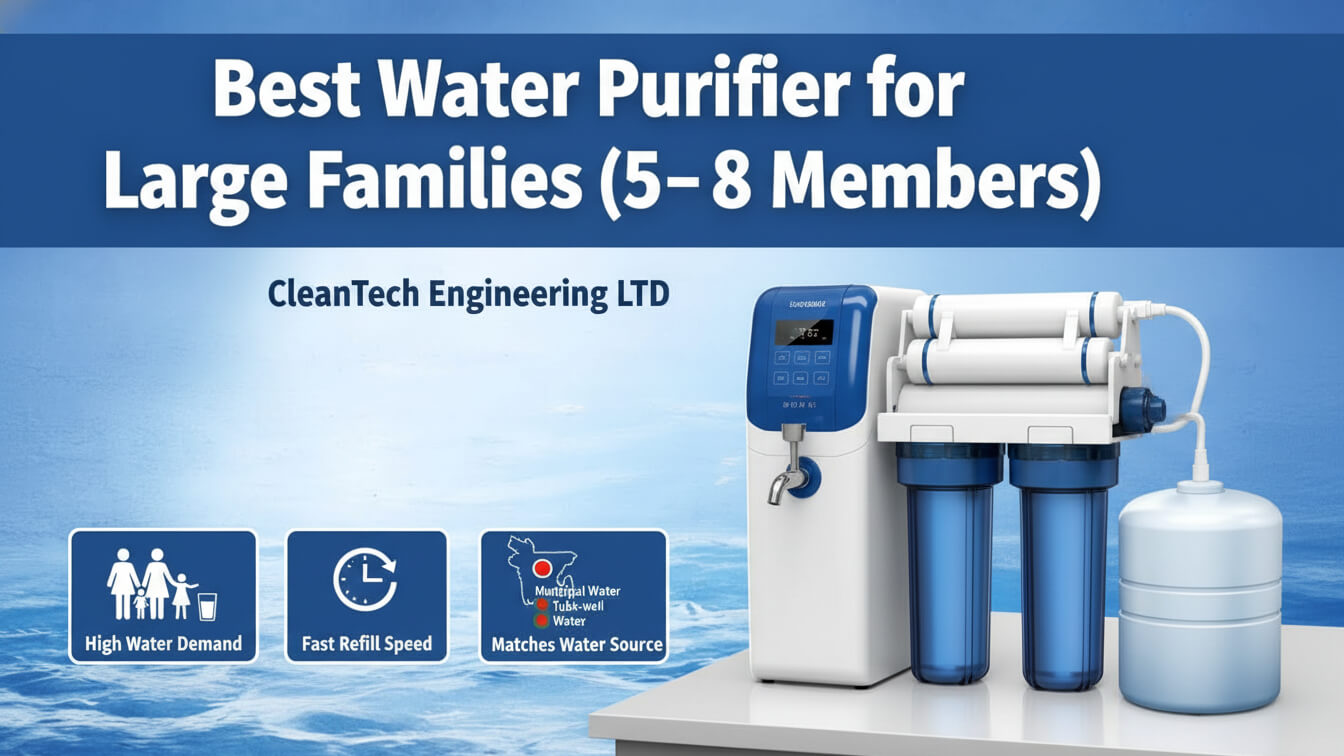
If you have a large family of 5–8 members, a water purifier has to do two things really well: store enough clean water and refill fast after everyone uses it. In many Bangladeshi homes, water use peaks in the morning and at night, and power cuts can happen too. That’s why I usually guide large families toward purifiers with bigger tanks and a reliable filtration system that matches the actual source water at home.
At CleanTech Engineering LTD, We offer household water purifiers that are designed for daily family use. You can choose from options depending on whether your water is a municipal supply or tube-well/borewell, and whether your main concern is TDS, taste, smell, or germ safety.
Quick recommendations for 5–8 members
If you want the simplest way to choose, start here.
If your home uses tube-well/borewell water or your water has a high TDS (hard, salty taste, scaling in kettles), I recommend an RO-based purifier because it is built to reduce dissolved impurities. For many large families, RO is the practical choice when water quality changes by season.
If you use municipal water and your TDS is not high, a UV/UF purifier can be enough for many homes. It can be a smart option if you want safe water without RO reject water.
If you care most about lower water wastage, the best approach is to choose the right technology for your water (don’t use RO if you don’t need it), maintaining filters on time, and reusing RO reject water for cleaning tasks.
If you prefer an alkaline/mineral taste, you can look for models that support a mineral/alkaline stage. I treat this as a taste preference, not a medical feature.
Compare before you buy (large family checklist)
When you are comparing purifier prices, don’t only look at the machine cost. For a family of 5–8, I suggest comparing these things together: purification type, storage tank size, refill/purification rate, and service + filter availability.
On your category page, you can keep a small comparison area above the products. Even if you don’t show exact numbers for every model, this helps shoppers choose faster:
- What purification type is it (RO / RO+UV+UF / UV+UF)?
- Is the storage tank big enough for rush hours?
- Is refill speed strong enough for family use?
- Does it suit your water source (municipal vs tube-well)?
- Is service and filter replacement easy in Bangladesh?
- What is the purifier price, and what is the estimated electric filter price (running cost) over time?
How I choose the right purifier for a family of 5–8
For large families, storage matters as much as filtration. A small tank may look fine in product photos, but in real life it can feel stressful when several people fill bottles back-to-back. For many 5–8 member homes, I usually aim for 10 liters or more storage so there is enough water during peak use and short power cuts.
Next is refill speed. Large families don’t want to wait long after the tank gets low. A purifier with a good purification rate makes daily life easier, especially when guests come or when cooking needs extra water.
The most important step is matching the purifier to the water source. RO systems are commonly used for higher TDS water and mixed sources. UV/UF systems are commonly used when the water is already low in dissolved solids and you mainly need protection from germs, sediment, and smell/taste issues.
One more honest point: RO systems produce reject water. This is normal for RO technology because it flushes out concentrated impurities. Some brands use marketing terms like “zero wastage,” but what matters is what the machine actually does in daily use. I suggest planning to reuse RO reject water for mopping, cleaning, toilet flushing, and other non-drinking uses when possible.
Pick the right purifier in 30 seconds
If you want a quick method, I use this simple rule:
If your water is municipal supply and you don’t have high TDS issues, start by checking UV/UF options first. If your water is tube-well/borewell, or your water quality changes a lot, start by checking RO options first.
After that, choose the tank size based on your family’s routine. If your home fills bottles for school, office, and cooking every day, go for a bigger storage tank. Then, choose the model that has the clearest service plan and easy filter availability, because a purifier only stays safe when filters are replaced on time.
Browse household water purifiers by type
RO water purifiers for large families
RO purifiers are often chosen in Bangladesh when water has higher TDS or mixed-source issues. For a family of 5–8, RO models with bigger storage and stable output usually feel the most comfortable for daily life. If you pick an RO purifier, I also recommend paying attention to maintenance, because filter condition affects both water taste and flow rate.
RO + UV + UF models
Some families prefer a multi-step setup because it feels more secure when water quality is uncertain. These models are often chosen by households that want RO performance plus additional disinfection layers. The right choice here depends on your water source, your maintenance comfort, and your budget.
UV/UF purifiers for municipal water
If your water is municipal supply and the main goal is germ protection plus clean taste, UV/UF options can be a good fit. Many families also like UV/UF because there is no RO reject water. The key is making sure UV/UF is suitable for your water quality, because it is not built for high TDS problems.
Alkaline/mineral preference models
Some customers like the taste of mineral/alkaline water. If you choose this type, I suggest treating it as a preference feature and asking about cartridge replacement cost and timing. It should never be sold as a cure for any health problem.
Large-family sizing guide (simple real-life view)
For a large family, water is not only for drinking. You also use filtered water for tea, coffee, cooking rice, baby food, and filling bottles. That is why storage matters so much. A bigger tank gives you breathing room during peak hours, and good refill speed helps the purifier recover quickly after heavy use.
If you often have guests, or if your family drinks a lot of water throughout the day, I suggest choosing the larger storage option available in your budget.
Maintenance and running cost (purifier price vs electric filter price)
Many people compare purifier prices but forget to ask about running costs. In simple words, the machine price is only one part. The real cost also includes the electric filter price over time, meaning replacement filters, service, and sometimes parts like UV lamps (for UV models) or RO membranes (for RO models).
In my experience, running cost changes based on your water. If your input water is very dirty or high TDS, filters can clog faster. If you replace filters late, the purifier may give slow water flow and poor taste, and it can also stress the system. So I always recommend planning filter changes as a normal household routine, like changing a gas cylinder or servicing an AC.
Safety notes (important for Bangladesh)
If you suspect arsenic in your area, don’t guess. Test your water and choose a solution based on that result. Arsenic exposure can cause serious health problems over time. For basic background, you can review the World Health Organization’s arsenic fact sheet. Source: WHO – Arsenic (fact sheet)
For a general drinking-water safety background, WHO also provides a broad overview here: Source: WHO – Drinking-water fact sheet
FAQs (large family focus)
Do I need RO for my home?
If your water is tube-well/borewell, or you have high TDS taste/scaling issues, RO is often the better fit. If your water is municipal and not high TDS, UV/UF may be enough. Testing is the safest way to decide.
What storage is enough for 6–8 people?
In many homes, a larger storage tank feels much better during busy times. That is why I often recommend 10 liters or more for 5–8 members, depending on your routine.
Is fast purification rate important if the tank is big?
Yes, because once the tank drops, a faster refill keeps your family comfortable. For large families, both storage and refill speed matter.
Is alkaline water necessary?
No. Many people choose it for taste. It should not be treated as a medical feature.
How can I reduce RO water wastage?
Use RO only when it is needed, maintain filters on time, and reuse reject water for cleaning tasks where practical.
What is included in the purifier price?
This depends on the seller. Always check if installation, filters, and service visits are included. Also ask about the electric filter price over one year so you understand the real cost.
Why you can trust CleanTech Engineering LTD
I focus on the basics that keep families safe: choosing the right purification type for the water source, recommending practical storage for family demand, and supporting customers with proper maintenance guidance. Clean water is a health topic, so I avoid exaggerated claims and stick to what the technology is designed to do.
