A Reverse Osmosis (RO) membrane is a semi-permeable, spiral-wound filtration element that removes dissolved salts, impurities, and contaminants from water using pressure-driven separation. It is the core component of an RO system and plays a critical role in producing high-purity water for residential, commercial, and industrial applications.
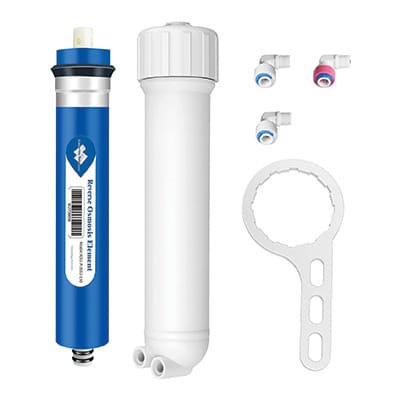
| Type | Description | Typical Use |
|---|---|---|
| 4040 (4″ × 40″) | Small commercial/industrial systems | Car washes, clinics, labs |
| 8040 (8″ × 40″) | Large-scale systems | Water plants, bottling, food processing |
| 1812 / 3012 | Compact residential sizes | Home RO units |
| BWRO Membrane | For brackish water | Industrial & municipal use |
| SWRO Membrane | For seawater (high pressure) | Desalination plants |
Key Features:
| Feature | Description |
|---|---|
| Material | Typically made of thin-film composite (TFC or TFM) polyamide |
| Micron Rating | ~0.0001 micron (removes particles much smaller than bacteria) |
| Salt Rejection | 95–99.8% depending on membrane type and water chemistry |
| Design | Spiral-wound configuration with permeate and brine spacers |
| Operating Pressure | 50–1200 PSI (varies by type: brackish vs seawater) |
Benefits:
-
Produces high-purity water (TDS reduction up to 99%)
-
Reduces chemical use in water treatment
-
Removes bacteria, viruses, heavy metals, nitrates, etc.
-
Long service life with proper pretreatment and maintenance
Maintenance & Replacement:
-
Membranes typically last 2–5 years
-
Require pretreatment (e.g., antiscalant, filters, softeners) to prevent fouling
-
Periodic chemical cleaning (CIP) extends membrane life
Applications:
-
Drinking water purification
-
Food & beverage industry
-
Pharmaceutical manufacturing
-
Power plants & boilers
-
Seawater desalination
-
Dialysis & ultrapure labs

 Industrial Water Plant