

 Industrial Water Plant



Domestic Water Purifier vs Commercial RO Key Differences

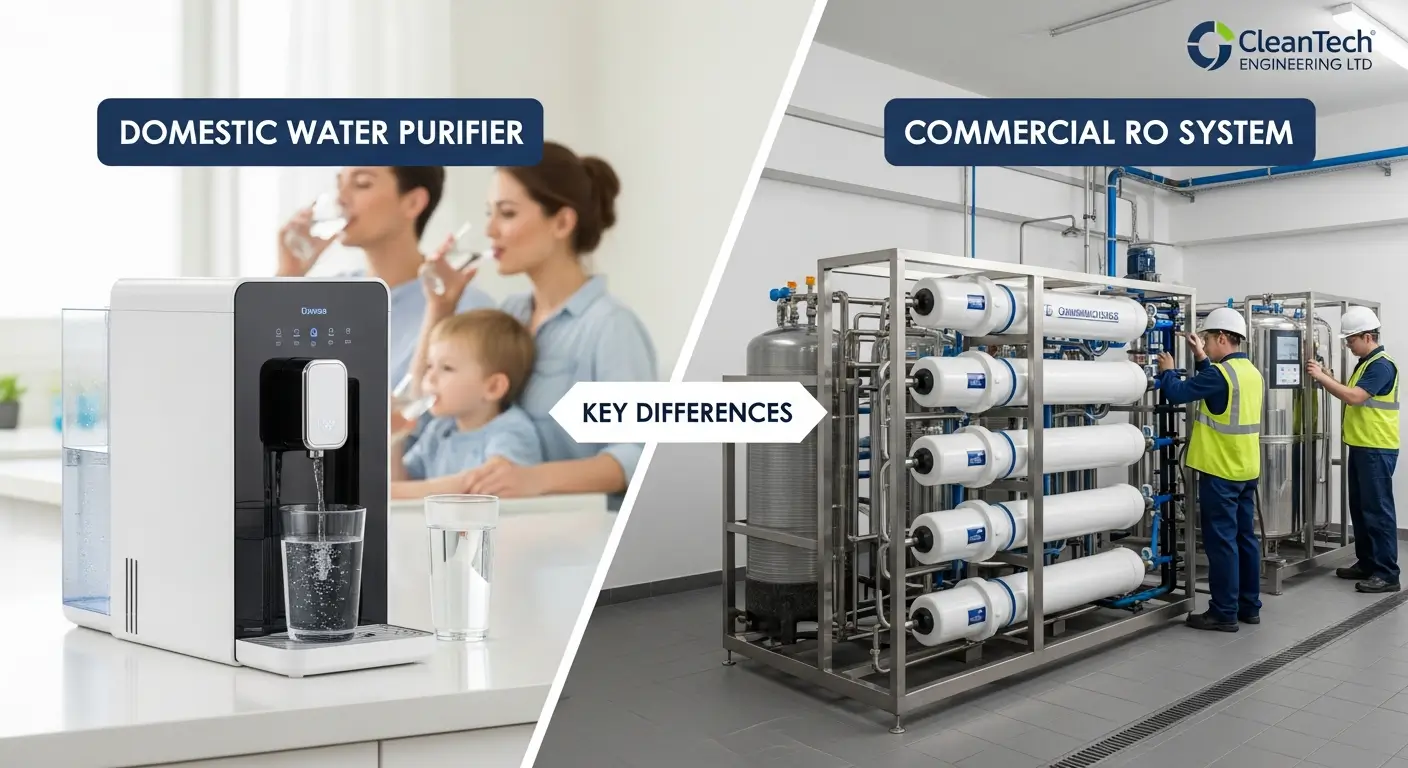
At CleanTech Engineering LTD, we often get asked about the differences between domestic RO purifiers and commercial RO systems. Both use the same reverse osmosis technology, but they are designed to serve different needs. Whether you’re a homeowner or running a large business, it’s important to understand which system will work best for you. Let’s break down the key differences so you can make an informed choice.
Domestic Water Purifier vs Commercial RO – Which One Is Right for You?
Brief Answer: The primary difference between a domestic water purifier and a commercial RO system is the scale. Domestic systems are designed for personal use in homes, while commercial RO systems cater to large-scale needs like businesses, hospitals, and factories.
Importance of Clean Water: In Bangladesh, clean drinking water is essential for health and safety. Whether you’re using it for your home, office, or industrial processes, having a reliable water purifier is crucial to avoid contamination.
Purpose of the Post: This article will guide you through the differences between domestic and commercial RO purifiers, helping you decide which one fits your needs. We’ll focus on key factors like capacity, cost, maintenance, and efficiency.
Primary Purpose and Usage
Domestic (Residential) RO
Target Audience: Ideal for families with 3-10 people, using water for drinking, cooking, and occasional use.
Usage: Designed for intermittent use, typically during peak hours, such as mornings and evenings.
Key Benefit: Helps remove contaminants like chlorine, lead, and bacteria, and improves the taste of tap water.
Commercial RO
Target Audience: Perfect for large-scale needs, such as in restaurants, offices, hospitals, factories, or anywhere large volumes of purified water are required.
Usage: Built for continuous 24/7 operation, serving hundreds or thousands of people with constant water demand.
Key Benefit: Designed to handle large volumes of water, meeting specific industry requirements such as high purity for medical or food-related processes.
Key Differences in Capacity and Flow Rate
Domestic RO
Flow Rate: Typically ranges from 10 to 75 Liters per Hour (LPH).
Daily Output: Generally produces between 18 and 150 gallons per day (GPD), making it sufficient for small families or individual use.
Usage Pattern: Ideal for smaller, predictable water needs, such as drinking water, cooking, and occasional cleaning.
Commercial RO
Flow Rate: Can handle much larger amounts, ranging from 100 to 1,000+ Liters per Hour (LPH).
Daily Output: Capable of serving environments with 1,000+ gallons per day, meeting the needs of large offices, factories, or public spaces.Usage Pattern: Designed for continuous use, ensuring large operations have access to water throughout the day and night.
Filtration Efficiency and Standards
Domestic RO
Filtration Stages: Typically includes 3 to 5 stages that filter out common contaminants such as chlorine, lead, pesticides, and bacteria.
Water Quality: Ensures safe drinking water, but it may not meet the industrial-grade standards required in some businesses.
Commercial RO
Filtration Stages: Often includes advanced stages, such as UV sterilization, deionization, and activated carbon filters for ultra-pure water.
Water Quality: Meets strict industrial and legal standards, especially for medical, food, or pharmaceutical applications.
Customization: Commercial systems can be tailored to meet specific requirements, like pharmaceutical-grade water or high TDS levels.
Durability and Cost
Domestic RO
Cost: More affordable upfront, typically costing between $200 to $600 (৳16,500 – ৳50,000 in BDT).
Materials: Built with plastic components, designed for home use and light-duty performance.
Maintenance: Generally user-friendly, with filter changes every 6–12 months and low maintenance requirements.
Commercial RO
Cost: Higher initial investment, ranging from $1,000 to $10,000+ (৳85,000 – ৳8,50,000 in BDT), depending on capacity and customization.
Materials: Built with stainless steel frames and high-performance pumps to handle continuous, heavy-duty use.
Maintenance: Requires professional servicing, including regular monitoring of pressure, water quality, and other components. Maintenance tends to be more frequent and detailed.
Customization and Installation
Domestic RO
Customization: Generally standardized units that don’t require much customization.
Installation: Easy to install, typically under-sink or wall-mounted, making them ideal for small homes or apartments.
Commercial RO
Customization: Highly customizable based on water quality requirements, such as high purity or specific filtration needs for various industries.
Installation: Requires professional installation in larger spaces, like utility rooms or dedicated areas for water treatment.
Water Recovery Rate and Waste
Domestic RO
Recovery Rate: Often has a lower recovery rate, typically around 25%. For every liter of water purified, about 3 liters may be wasted.
Waste Water: Advances in technology are improving efficiency, but waste water can still be a concern.
Commercial RO
Recovery Rate: Commercial systems typically have a higher recovery rate, ranging from 50% to 75%, which reduces water wastage.
Waste Water: Designed to minimize water waste, making them more efficient in the long run.
Pros and Cons: Domestic vs Commercial RO
| RO System Type | Category | Key Points |
| Domestic RO | Pros | 1. Lower initial cost 2. Ideal for small spaces 3. Simple installation and easy maintenance |
| Domestic RO | Cons | 1. Not suitable for high-volume use 2. Higher water wastage compared to commercial systems |
| Commercial RO | Pros | 1. Handles large-scale water requirements 2. Can be tailored for specific industry needs 3. Higher recovery rates with less wastewater |
| Commercial RO | Cons | 1. Requires significant upfront investment 2. Needs larger space and professional setup 3. Requires regular professional servicing |
Conclusion: Choosing Between Domestic and Commercial RO
Choosing between a domestic RO and a commercial RO depends on your needs. If you’re a homeowner or have a small office, a domestic RO is ideal. It’s cost-effective, compact, and efficient for personal use. However, if you manage a larger-scale operation like a hospital, restaurant, or factory, a commercial RO system is the best choice due to its higher capacity, efficiency, and customization options.
Call to Action: Explore our range of RO solutions at CleanTech Engineering LTD. Whether you need a Domestic RO for your home or a Commercial RO for your business, we have the perfect system for you. Visit our website to learn more and make a purchase today.
FAQs: Answering Common Questions
Can a domestic RO system be used for a large office?
A domestic RO system may work for small offices with low water consumption, but a commercial RO system is more suited for high-demand situations.
What is the lifespan of a commercial RO system?
A commercial RO system can last 10–15 years with proper maintenance, depending on usage and environmental conditions.
Are commercial RO systems more energy-efficient?
Yes, commercial systems generally have higher recovery rates and are more efficient, especially in large-scale operations where continuous use is required.
