

 Industrial Water Plant



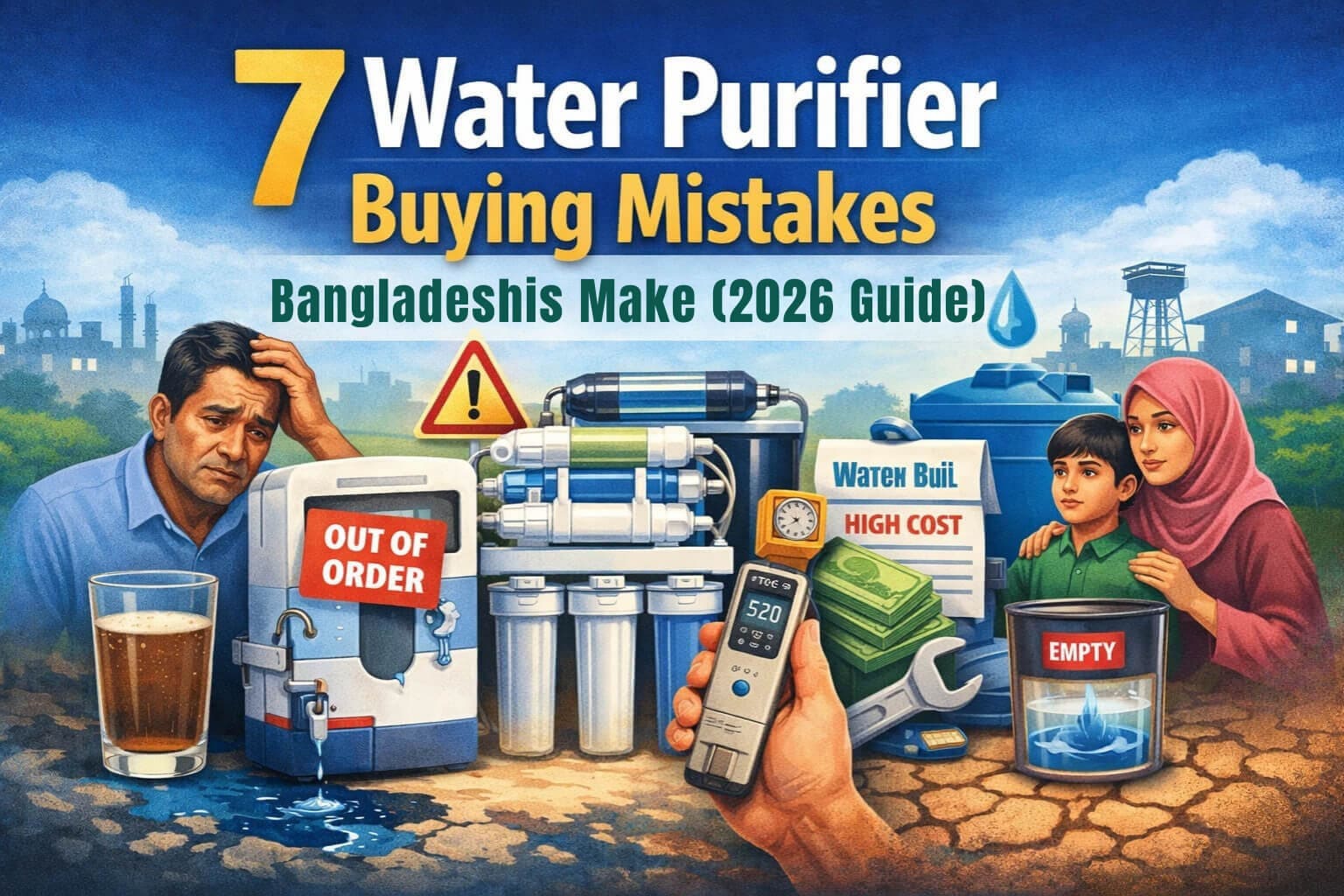
7 Water Purifier Buying Mistakes Bangladeshis Make (2026 Guide)

Introduction: The High Stakes of Clean Water in Bangladesh
Here’s something I see every week at CleanTech Engineering. A customer walks in with a 2-year-old water purifier. It stopped working. They paid 25,000 taka for it. Now, they can’t find filters. The company that sold it? Gone. Closed shop.
This happens more often than you think. Almost 90% of urban families in Dhaka, Chittagong, and Sylhet now use some type of water filter. But here’s the problem: most of them bought the wrong technology for their area.
The water in Dhanmondi is not the same as water in Chandpur. The purifier that works for WASA supply will fail miserably on deep tube-well water. I’ve been in the water purifier business for years, and this guide will help you avoid the expensive mistakes I see Bangladeshi consumers make every single day.
Mistake 1: Skipping the TDS & Contamination Test
The short answer: Never buy a water purifier based on someone else’s recommendation. Your water is different from theirs.
Your neighbor in Uttara might swear by their UV purifier, but if your building uses a deep tube-well and theirs uses a WASA line, you have completely different problems.
What is TDS and Why Should You Care?
TDS means Total Dissolved Solids. It measures minerals, salts, metals, and chemicals dissolved in your water.
| TDS Level | What It Means | Recommended Technology |
| Below 300 ppm | Low TDS (Usually WASA water) | UV or UF purifier |
| 300-500 ppm | Medium TDS | UV with sediment filters or basic RO |
| Above 500 ppm | High TDS (Deep tube-well/Coastal) | RO is necessary |
| Above 1000 ppm | Very High TDS | Heavy-duty multi-stage RO |
My advice: Before you spend a single taka, test your water first. You can buy a TDS meter for 300-500 taka or ask us for a free test.
Mistake 2: Falling for the “More Stages = Better” Marketing Trap
The short answer: A 12-stage purifier is not better than a 6-stage one. It’s just better marketing.
What are those extra stages? Usually, the same thing is repeated multiple times. The core technology does 99% of the work.
What Actually Matters?
- RO (Reverse Osmosis): Removes salts, arsenic, and lead.
- UV (Ultraviolet): Kills bacteria and viruses.
- UF (Ultrafiltration): Removes bacteria without electricity.
What to Look For Instead: Forget counting stages. Look for BSTI, NSF, or WQA certifications. A certified 5-stage purifier will outperform an uncertified 15-stage machine every time.
Mistake 3: Using Reverse Osmosis (RO) Where It’s Not Needed
The short answer: RO is powerful, but using it on already-clean water can actually make your water “dead.”
RO removes everything—the bad stuff like lead, but also the good stuff like calcium and magnesium. If your WASA supply already has low TDS, RO strips away healthy minerals.
The Health Concern
Long-term drinking of mineral-free water can cause mineral deficiency and tasteless water. If you must use RO on low-TDS water, ensure your machine has:
- TDS Modulator (MTDS): Controls mineral retention.
- Mineral Cartridge: Adds back essential minerals.
- Alkaline Filter: Balances pH levels.
Mistake 4: Ignoring Long-Term Maintenance & Filter Costs
The short answer: That “cheap” purifier will cost you more in the long run if filters are expensive or proprietary.
The real cost of a purifier is maintenance. A typical RO system needs regular changes:
| Filter Type | How Often to Change | Typical Cost (BDT) |
| Sediment Filter | Every 3-6 months | 200 – 400 |
| Pre-Carbon Filter | Every 6-9 months | 300 – 600 |
| RO Membrane | Every 12-24 months | 1,500 – 4,000 |
| UV Lamp | Every 12 months | 800 – 1,500 |
The Real Trap: Some companies sell machines for 15,000 taka but use “special designs” so you have to buy their 6,000-taka replacement membrane. At CleanTech, we use industry-standard filters you can find anywhere.
Mistake 5: Overlooking After-Sales Service & Spare Parts
The short answer: A water purifier without service support is e-waste waiting to happen.
Purifiers are mechanical. Pumps fail, and O-rings leak. If your brand doesn’t have a service center in your city, you’re stuck.
How to Protect Yourself
- Verify the brand has a service center in your city.
- Check for at least a 1-2 year warranty.
- Test the helpline number before you buy.
Mistake 6: Not Considering Water Wastage
The short answer: Standard RO systems waste 3 liters of water for every 1 liter of pure water.
RO works by “rejecting” dirty water. In water-scarce areas of Dhaka like Mirpur or Old Dhaka, this waste adds up.
Better Options
- Low-Waste RO: Modern systems achieve better ratios (some 1:1).
- Reuse Reject Water: Use it for mopping, flushing toilets, or watering plants.
- Skip RO: If your TDS is below 300 ppm, a UV or UF system produces zero waste.
Mistake 7: Miscalculating Storage Capacity vs. Family Size
The short answer: Buy a tank that can serve your family for 6-8 hours without power.
RO and UV purifiers need electricity. If you have a 3-hour load-shedding and an empty tank, you have no water.
Tank Size Guide
- 2-3 people: 8-10 liters
- 4-5 people: 12-15 liters
- 6-8 people: 18-20 liters
Bonus: Area-Specific Water Problems in Bangladesh
- Mirpur/Old Dhaka: High sediment. You need frequent pre-filter changes.
- Chittagong Coastal: High salinity. RO is mandatory.
- Sylhet: Generally good, but watch for high iron content.
- Khulna/Barisal: High arsenic risk. Must use arsenic-specific RO.
Your Pre-Purchase Checklist
- TDS Level: Is it below or above 300?
- Water Source: WASA or Borewell?
- Certifications: Does it have BSTI/NSF/WQA?
- Service: Is there a local service center and working helpline?
- Ongoing Costs: What is the 3-year maintenance cost?
Why CleanTech Engineering?
We don’t just sell machines; we sell solutions.
- We Test Before We Sell: We recommend technology based on your water data.
- Standard Parts: We use universal filters so you’re never “locked in.”
- Truthful Recommendations: If a cheaper UV system is enough for you, that’s what we’ll suggest.
Confused about which purifier fits your area?
Browse our 2025 Collection or talk to our experts for a FREE water quality consultation.
Contact CleanTech Engineering Ltd today.
📞 Call/WhatsApp: 01701-666 606
